Ministry and counseling are now my part-time vocations. These days, I work full-time among the trees as an arborist. My boys call me the Lorax. “You speak for the trees!” they declare. And they’re not wrong—I do advocate for them, at least to our clients. This unexpected path places me squarely in the middle of God’s creation nearly every day, far from the chatter of crowds and surrounded instead by forests, mountains, and uncultivated land.
In these quiet spaces, I’ve often thought of Robert Frost’s poetry, which captures nature’s serene indifference to human life and worries. In one poem about sea nature, “Neither Out Far Nor In Deep,” Frost describes people gazing endlessly at the sea, turning their backs to the solid land. “The water comes ashore, And the people look at the sea.” His point is that nature, whether it be sea or forest, exists in a continuous, rhythmic way—with or without our notice.
Standing in a patch of trees, I’ve often been struck by that same truth. The birds eating insects, the moss spreading over bark, and the quiet scurrying of creatures. It all continues whether I’m here to notice it or not.
When we step into nature, we glimpse [God’s] splendor. In that seeing, we are transformed.
The expanse around me makes one thing clear: I am very small. It’s a powerful, even overwhelming realization—yet deeply peaceful. For if God sustains the forest without my awareness, what else might he be up to in my life that doesn’t require my control or constant attention?
Perhaps I don’t need to be in charge as much as I assume. Maybe I’m not in control of as much as I want to believe. And maybe—just maybe—my life can truly rest secure in the hands of the one who clothes the fields and feeds the birds of the air (Matthew 6:26).
And, what would that mean? What comes next?
Transformation. Growth. The slow, sure shaping of my heart into the likeness of my Creator, even if it’s just a little bit more than before. You see, every part of this world displays his glory, goodness, and love (Psalm 19). When we step into nature, we glimpse his splendor. In that seeing, we are transformed.
What Nature as Soul Care Is (and Isn’t)
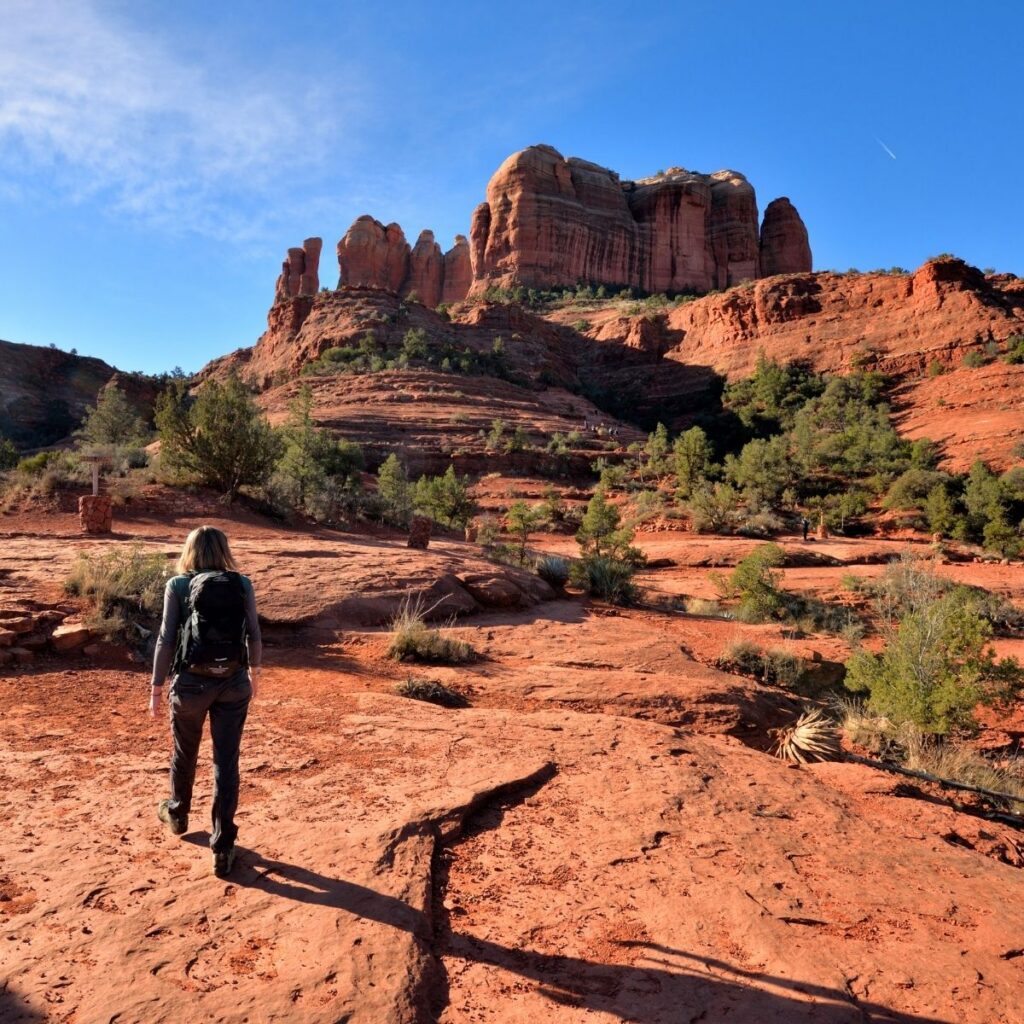
It’s important to approach this practice with clarity. Nature as soul care isn’t about escape or becoming a hermit on the sea, or in the woods. Jesus often went into the wilderness, but he did so to prepare for his mission, not to avoid it.
Most essentially, we worship the Creator, not the creation. God is not in the trees or the waves; he is the Maker of them all. He holds it all together (Colossians 1:27). As Psalm 24:1 reminds us, “The earth is the Lord’s.” The earth is not the Lord himself, but it belongs to him and speaks of him.
So what is nature as soul care? It is akin to the disciplines of silence and solitude, or retreat. As writer Gary Thomas beautifully says, it is “to leave formal architecture and the padded pews to enter an entirely new ‘cathedral,’ a place that God himself has built: the outdoors.”1 Although, I would say that the “cathedral” is not really new; it’s as ancient as the creation of the world in Genesis 1.
We venture into God’s cathedral not just to be outside but as a means to connect with the living God. We bring our worries and wonders into his spacious presence, allowing the setting to turn our gaze from the gift to the Giver.
God Heals Through Nature
Unless we belong to God through faith in Jesus Christ, nature remains just nature—beautiful but lacking its full, soul-restorative power. When God is our Physician however, his creation becomes a venue for his healing work. We avoid mere sentimentality and idolatry and instead see the world as a canvas of his character—his true person. This in turn mirrors back to us our true person.
Again, Gary Thomas is a great resource for nature as soul care. In his book, Sacred Pathways, he suggests this happens through perceiving nature; truly taking notice.2 Here are a few ways to start:
- Consider the “greatness” of creation. Observe the towering mountains, the vast sky, the expansive seas. Let their scale remind you of the infinitely greater power, wisdom, and goodness of our triune God.
- Consider the “multitude” and “abundance” of creation. Notice the incredible variety of life—the different plants, insects, and animal life. In my work in the trees, I see more activity at my feet than I could ever fully comprehend. This multitude reflects God’s generous, creative mind.
- Consider the “beauty” of creation. What captures your eye and stirs your heart? The curve of a branch, the gradient of a sunset, the intricate pattern on a seashell or leaf? Behold beauty that is deep, high, and wide, not thin or fleeting. Consider the kind of beauty God paints into existence.
As you perceive, prepare to receive. This is where healing often flows. Come expectantly. Set aside your agenda and ask God to speak. Let him, through the grandeur and the gentleness of this world, search your heart, find you, and remind you there in God’s “cathedral” that you are fully known and deeply loved.
Putting Nature as Soul Care into Practice
Practical transformation is always God’s work. Our part is to place ourselves intentionally on the paths he calls us to so we can receive his refinement. Placing ourselves in nature is one of those pathways.
Here are a few simple suggestions to get you started:
- Move your daily Scripture reading and prayer time to a porch, a park bench, or under a tree.
- Take your breaks or lunch outside. Go for a short walk, feel the grass or rocks under your feet, and ask the Lord to reveal himself to you.
- Plan a weekly hike or walk. Before you go, pray silently or with others, “Lord, walk with us and show us yourself. If you desire, show us yourself through your creation.”
- Consider scheduling a monthly or quarterly outdoor retreat. It can be camping, a cabin by water, or even a long afternoon in a botanical garden.
- If possible, once a year, take a full weekend to be outside with God.
- Encourage your church to plan a retreat at a camp, concluding your time together with a worship service under the open sky.
In God’s Cathedral
Yes, I speak for the trees. I love the trees, and it’s powerful when I sense the Lord there with me on the forest floor. While in God’s cathedral, I’m learning to listen for the voice of the one who sustains them, and me, even when I don’t notice it.
What will you notice—when you are in God’s cathedral?
Get outside and give attention. As you do, seek his face first. Hold your plans loosely, let your mind rest in him, and don’t rush. May you encounter God in a profound way and find your soul nurtured.